
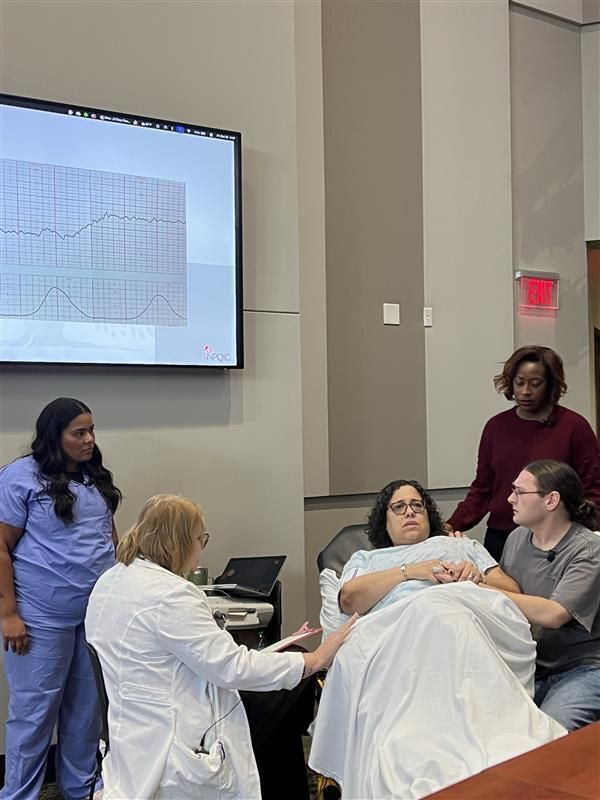
At the 2026 NPQIC Fall Summit, attendees experienced a different kind of learning opportunity. Rather than hearing about trauma-informed care through a lecture or presentation, participants watched NPQIC's first live simulation scenario, designed to bring trauma-informed care principles to life during a realistic obstetric emergency, with pauses throughout the scenario for panel discussion and audience reflection.
The simulation followed Sarah, a first-time mother facing a rapidly evolving preterm pregnancy complication requiring urgent decision-making, multidisciplinary collaboration, and family-centered communication. As the clinical situation escalated, attendees witnessed not only the medical management of a high-risk pregnancy, but also the powerful impact of words, body language, empathy, and shared decision-making on a patient's experience.
The panel discussion was moderated by Dr. Lovgren and included insight from Dr. David Soffer, neonatologist and ethicist; Shari Flowers, attorney; Liz Siedhoff, labor and delivery nurse; and Tracy Pella, patient advocate and mental health practitioner. Their discussion reinforced a critical message: Excellent clinical care and trauma-informed care are not separate goals. They must occur concurrently.
Beyond the Diagnosis
One of the most powerful themes that emerged was the importance of recognizing that patients experience emergencies differently than the clinicians caring for them. While healthcare professionals may routinely care for patients with severe preeclampsia, HELLP syndrome, preterm or routine birth, for the patient and family, the event is often life-changing. As Tracy Pella noted,
"For me, this is my experience, and this is my world."
The discussion highlighted the importance of slowing down long enough to understand what a patient may be experiencing emotionally, even when clinical urgency demands swift action.
Communication Is a Clinical Skill
Panelists repeatedly emphasized that trauma-informed care is not about saying the perfect thing. It is about creating an environment where patients feel seen, heard, respected, and involved.
Simple practices discussed included:
- Slowing down in crucial moments.
- Sitting down to connect.
- Making eye contact.
- Asking permission before touching or performing assessments.
- Explaining what is happening and why.
- Inviting questions.
- Checking for understanding.
- Including support persons in conversations whenever possible.
Dr. Soffer shared a communication strategy that resonated across the audience,
"Once you give your punchline about the bad news, take a pause. Count to 8 seconds in your head. Let it sit."
In healthcare, silence can feel uncomfortable. For patients receiving life-changing information, however, those few seconds may provide the space needed to absorb information, process emotions, and formulate questions.
Restoring Control During a Crisis
A key principle of trauma-informed care is recognizing that illness, emergencies, and hospitalization often create feelings of powerlessness. Throughout the panel discussion, speakers stressed the importance of returning control to patients whenever possible, even through small actions. This may include offering choices, asking for consent before interventions, explaining next steps, or inviting patients to participate in decisions affecting their care. Liz Siedhoff highlighted an important shift in perspective,
"Trauma-informed care isn't asking, 'What's wrong with you?' It's recognizing and asking, 'What happened to you?'"
That simple reframing changes how healthcare teams approach communication, behavior, anxiety, and decision-making during stressful situations.
The Grief Behind the Emergency
Another meaningful discussion centered on recognizing grief in moments of unexpected change. For Sarah, the emergency was not simply a medical diagnosis requiring treatment. It represented the sudden loss of pregnancy, birth experience, and expectations she had envisioned. The panel encouraged attendees to remember that patients may need acknowledgment of their emotions before they can fully process medical information. Recognizing loss, validating emotions, and creating space for patients to express fears can strengthen trust and improve communication during some of the most difficult moments in care.
Words Matter
The discussion also highlighted how language can influence a patient's experience.
Panelists encouraged teams to examine common phrases used in healthcare and consider how they may be perceived by patients and families. Dr. Lovgren shared an example of word choice that sparked discussion: the difference between documenting that a patient "refused" care versus noting that a patient "declined" an intervention after receiving information and participating in decision-making. Shari Flowers added that clinicians must be tender to ensure clear risk- benefits are relayed in a non-coercive manner. Small language choices can either foster collaboration or unintentionally create tension. As Tracy Pella shared,
"Tell me honestly what the news is, but tell me with care."
Trauma-Informed Care Requires a Team
The simulation demonstrated that trauma-informed care is not the responsibility of a single clinician. Nurses, physicians, advanced practice providers, doulas, neonatal teams, support persons, and patient advocates all contribute to how patients experience their care. Every interaction can either build trust and connection or add stress during an already vulnerable time. Audience discussion reinforced the critical role doulas and support persons can play in helping patients and families navigate unexpected outcomes, understand information, and maintain a sense of connection during rapidly changing situations. For example, doula Cydney Gaines added ‘can we pause, this was a lot of information, and I want to make sure we all understand what is happening’ guided the birth team to restart together in navigating communication.
Bringing the Lessons Home
The live simulation challenged attendees to think beyond clinical interventions and consider how care is experienced from the patient's perspective. Audience discussion reinforced the critical role doulas and support persons can play in helping patients and families navigate unexpected outcomes, understand information, and maintain a sense of connection during rapidly changing situations.
The session served as a powerful reminder that trauma-informed care is not a checklist or a separate initiative. It is an approach to care that recognizes the humanity behind every clinical encounter. Even in moments of uncertainty, urgency, and fear, trauma-informed care helps patients and families feel informed, respected, supported, and included in their own healthcare journey.
Simulation is a powerful tool for building these skills because it allows teams to practice difficult conversations, interdisciplinary collaboration, and patient-centered communication in a safe learning environment. Through NPQIC's simulation supply initiative as funded by CMS, every Nebraska delivery hospital now has access to a Mama Natalie and Newborn Anne that can support training experiences like this one within their own setting. By incorporating simulations into routine education and drills, teams can strengthen both clinical readiness and trauma-informed care practices, ensuring they are prepared to provide exceptional care when real emergencies arise.
As the simulation demonstrated, urgency and humanity are not competing priorities. The most effective care delivers both.
(Simulation materials supplied by CMS. Learn more about CMS funding at dhhs.ne.gov/RHTP)


